I'm a Lecturer in Applied and Computational Mathematics at the University of Edinburgh.
I'm interested in understanding the statistical and dynamical behavior of turbulence and sediment transport using a combination of direct numerical simulations, simplified models, and statistical descriptions.
Research Areas
My research focuses primarily on turbulent flows, whether that's understanding how turbulence behaves in geophysical or engineering settings, or how its presence influences the statistics of sediment transport in rivers. My approach is largely computational, relying on a hierarchy of models spanning direct numerical simulations, intermediate-complexity lattice or cellular automata models, and simple statistical descriptions of the dynamics. Below I give a brief highlight of my three main research areas. See my Research Highlights page for more details.
Turbulent cascades
and phase dynamics
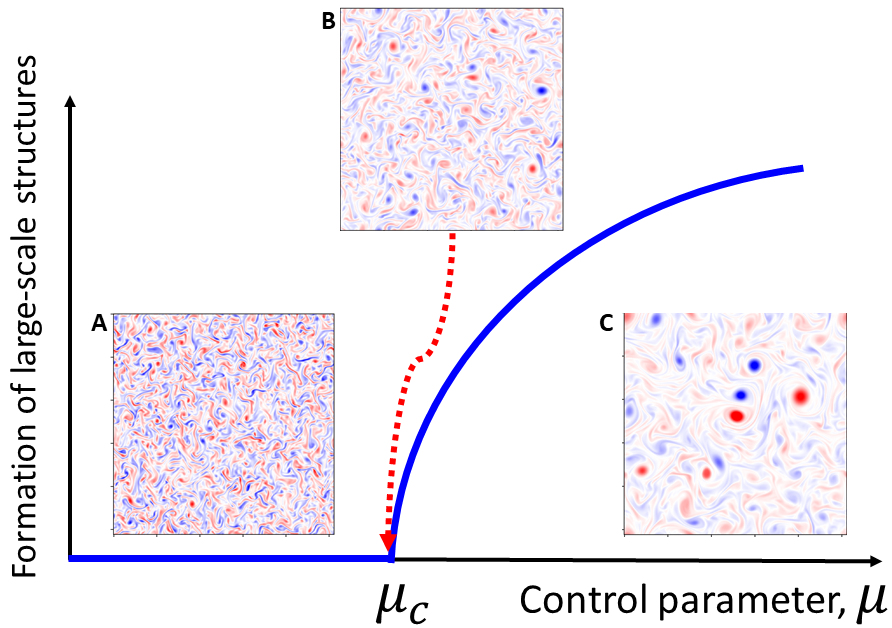
Turbulent flows transfer energy across scales in what is known as a turbulent energy cascade. The turbulent energy cascade in two-dimensional and geophysical flows is strikingly different from that of isotropic three-dimensional flows. My research aims to uncover the mechanisms which drive the energy cascade in these various settings and understand what causes the observed change in behavior. In particular, I focus on the role that triad phases play in the energy cascade.
Transition to turbulence and wall-bounded shear flows
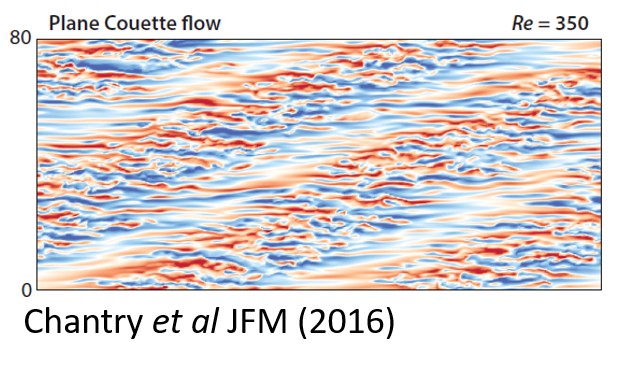
Wall-bounded shear flows, such as pipe flow or the flow between to plates, exhibit striking large-scale patterns that emerge at different flow speeds. In plane Couette flow, oblique laminar-turbulent bands appear at low speeds (see figure below), whereas at high speeds flow-aligned 'roller' vortices span the whole domain. My research aims to understand why these patterns form and what sets their properties, such as angle and length-scales.
Sediment transport
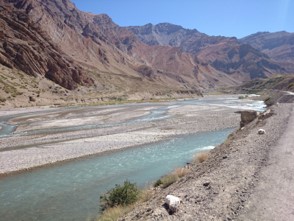
In bed load sediment transport, grains are moved by turbulent flow and are in nearly continuous contact with other grains. Despite their chaotic and unpredictable trajectories, each individual grain ultimately contributes to the ordered, large-scale properties of the river they are a part of - from the way it transports sediment to its width and shape. My research aims to understand this connection from grain to river scales using a series of intermediate-complexity models and simplified statistical approaches.